

Financial circumstances change. You may be asking yourself, “Can I refinance a personal loan?” In most cases, the answer is yes, but refinancing generally means taking out a new loan to pay off the old one. Is that a good move? This guide will help you answer that question. We’ll cover when it may help, when it may not, and how to explore your options.
What Does It Mean to Refinance a Personal Loan?
Personal loan refinancing is more common than you might think. It’s the process of replacing your current loan with a new one, either from your existing lender or a different lender. The new funds pay off the old balance and you repay the new loan. Refinancing doesn’t erase the old debt. It changes the arrangement: who you pay, how much, and or for how long.
Why Might Someone Refinance a Personal Loan?
Common reasons include:
- Changes in credit or income. If your credit or income has changed, you may want to see what terms are available now.
- A lower interest rate. A lower rate could reduce your interest costs, depending on the term and fees.
- A lower monthly payment. A longer repayment term can shrink the payment, but it can also increase the total interest you pay.
- A faster payoff. A shorter term can help you finish sooner, though the payment may be higher.
- Consolidation or additional funds. Some borrowers use a new loan to consolidate eligible debts or borrow an additional amount, subject to the lender’s criteria.
When Refinancing a Personal Loan May Not Make Sense
Refinancing may not be worth it when:
- Your current loan is nearly paid off, leaving little time for a meaningful benefit.
- The new rate, fees, or total cost would be higher.
- A longer term lowers your payment but adds more interest over the life of the loan.
- Your current loan has a prepayment penalty, or the new loan has costs that outweigh the savings. Since refinancing prepays the original loan in full, check your agreement for early payoff fees.1
The takeaway: compare the full offer, not just the monthly payment.
What Lenders May Consider for Personal Loan Refinancing
Refinancing requires a new loan application, so lenders may review:
- Credit history and credit score
- Payment history on existing debts
- Income and ability to make monthly payments
- Debt-to-income (DTI) ratio and other underwriting criteria
- Outstanding loan balance and requested loan amount
Each lender sets its own criteria. At 1st Franklin Financial, for example, loan terms may depend on factors such as credit history, income, existing debts, and the ability to provide collateral, among other considerations.
2 If a lender offers prequalification, remember that a prequalified offer is not a guarantee of approval.
How to Refinance a Personal Loan
1. Review Your Current Loan
It may have been a while since you last looked at your original loan agreement. Check the current payoff amount, interest rate, monthly payment, and remaining term. You’ll also want to look for any prepayment penalties that could increase the cost of refinancing.
2. Check Your Credit and Budget
Your credit report is available for free at several online locations. Check the most current version to ensure it’s accurate. Review your credit report for existing debt obligations and compare them with your monthly budget and expenses.
3. Compare New Loan Offers
Don’t rush the process. It’s better to take your time and field several loan offers. Compare the annual percentage rate (APR), which combines the interest rate with lender fees, along with the repayment term, monthly payment, finance charges, fees, and total repayment amount.3
4. Apply for the New Loan
Submitting a full application will subject you to a hard credit inquiry that shows up on your credit report. Many lenders offer a rate check or prequalification that uses a soft inquiry instead, which doesn’t affect your credit score.4 You can use that to review some preliminary offers.
5. Confirm the Old Loan Is Paid Off
Don’t stop paying on your old loan until you receive written confirmation that it’s been paid off. There may be a slight time delay that could extend past your next payment due date. You’ll also want to make sure you start making on-time payments for the new loan.
What to Compare Before You Refinance
Review these points for each offer before you refinance a personal loan:
- APR and interest rate
- Monthly payment and repayment term
- Total of payments and finance charges
- Origination, application, or prepayment fees, if applicable
- Whether the loan is secured or requires collateral
- Funding timing and how your current loan will be paid off
In the hypothetical example below ($5,000 balance, fixed rates, no fees), a lower APR and a longer term pull in different directions:
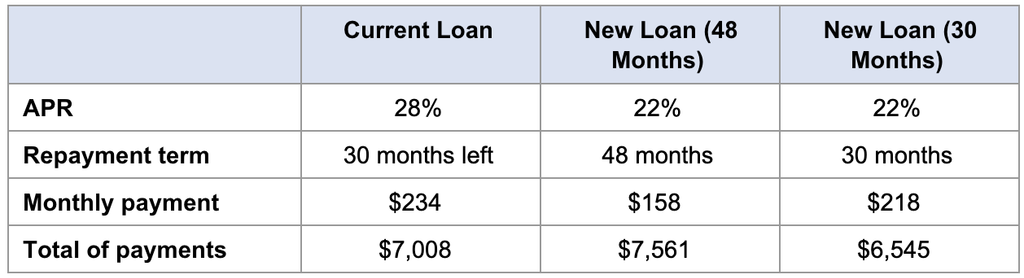
The 48-month option has the lowest payment, but it costs about $550 more than keeping the current loan. The same lower APR on a 30-month term saves about $460. These “big picture” numbers are important for long-term financial planning.
Can You Refinance a Personal Loan With the Same Lender?
This varies by lender. Some will allow existing borrowers to refinance a personal loan with them, while others won’t. Ask your current lender what’s available. If they do offer refinancing, don’t assume they’ll give you the best rates and terms. Use their offer to start your comparison shopping with other lenders. You may find a better deal elsewhere.
How Refinancing Can Affect Your Credit
The effects of refinancing on your credit report vary by individual. Here are some of the things you should be aware of:
- Hard inquiry. A full application can trigger a hard inquiry, which may temporarily affect your score. FICO® Scores count inquiries from the past 12 months, though they can stay on your report up to two years.4
- Account changes. Opening a new account and paying off an existing account may affect factors that are considered in certain credit scoring models, including the age of accounts and types of credit used.5
- Payment history. Making payments on time may help support a positive payment history over time, while late or missed payments may have a negative impact on creditworthiness.5
FICO’s rate-shopping window, which groups similar inquiries into one, covers mortgage, auto, and similar loans, so separate personal loan applications may each count.4 Prequalification, which only involves a soft inquiry on your credit, can be a helpful first step.
Explore Your Personal Loan Options
Create a budget based on your income and expenses before you start this process. Use that when comparing rates and terms. At 1st Franklin Financial, you can get a prequalified offer using a soft credit inquiry that generally does not affect your credit score. You can then talk through your options with the Friendly Franklin Folks at your local branch. Explore our personal loans, and review the loan checklist so you know what to bring.
Frequently Asked Questions
Sources
1. Consumer Financial Protection Bureau, “Can I prepay my loan at any time without penalty?” https://www.consumerfinance.gov/ask-cfpb/can-i-prepay-my-loan-at-any-time-without-penalty-en-843/
2. 1st Franklin Financial, “Prequalify for Personal Loans Online.” https://www.1ffc.com/
3. Consumer Financial Protection Bureau, “What is the difference between a loan interest rate and the APR?” https://www.consumerfinance.gov/ask-cfpb/what-is-the-difference-between-a-loan-interest-rate-and-the-apr-en-733/

